
Why We Don't Rate Every Engine the Same Way: The Limits of Our Data

When researching a new engine, it's natural to look for a definitive price. However, the reality of engine replacement costs is that they are never perfectly precise. The final figure depends on a complex mix of variables, making a single “fixed” price impossible.
At EnginesMarket, we don't give you one definitive price. Instead, we provide accurate, evidence-led cost intelligence and a transparent marketplace. Our authority comes from our proprietary data—24,650 real quote requests from UK vehicle owners—combined with insights from our network of vetted specialists.
Our mission is to explain how we rate cost data and, more importantly, why our ratings vary. By understanding the data's capabilities and its limits, you can make a more informed decision.
For the full methodology and the complete 2025 dataset (24,650 enquiries, 62 engines, 300+ models), see the Engine Market Intelligence Hub.
What Our Data Actually Shows
The foundation of our cost intelligence is real-world data: 24,650 unique quote requests in 2025. We don’t rely on national averages or theoretical price lists. Our data shows what actual UK vehicle owners were quoted for replacement engines, giving you the best possible insight into market reality.
This data reveals significant trends. For example, reconditioned engines were chosen in 70.45% of cases [EM-VERIFIED], making them the most popular choice for the majority of owners seeking a balance of cost and reliability. As a marketplace, we connect you with vetted UK specialists to compare quotes from this data-driven foundation. But what does “reliable” mean in this context?
The key is to understand that a quote request is not a fixed transaction price. It’s a snapshot of market conditions and a vehicle’s specific situation. This is why you’ll see price ranges—reflecting the real-world variation in the engine replacement market.
The Variables That Change Everything
Many factors influence the final cost of an engine replacement. Understanding these variables is crucial to interpreting our data and using it for your decision.
The Engine Itself (Supply Cost)
The base cost of the engine varies wildly depending on its design, rarity, and condition. Our per-engine request volumes highlight which engines are most in demand, but this doesn’t always correlate with cost.
Volume vs. Cost: The BMW N47D20C is our most requested engine with 1,450 enquiries [EM-VERIFIED], and its cost reflects its commonality and the complexity of its design. In contrast, a high-performance unit like the BMW S63B44 (410 enquiries [EM-VERIFIED]) is far more expensive due to its complexity and rarity.
Engine Type: A simple, common engine like the Ford DV6 1.6 TDCi [EM-VERIFIED] is relatively cheap. A complex, heavy-duty engine like the Land Rover 306DT SDV6 [EM-VERIFIED] is far more expensive, with a supply cost range of £6,500 to £9,500 [EM-QUOTE]. This £3,000 range alone shows that condition and the engine's history are highly variable.
Labour Costs
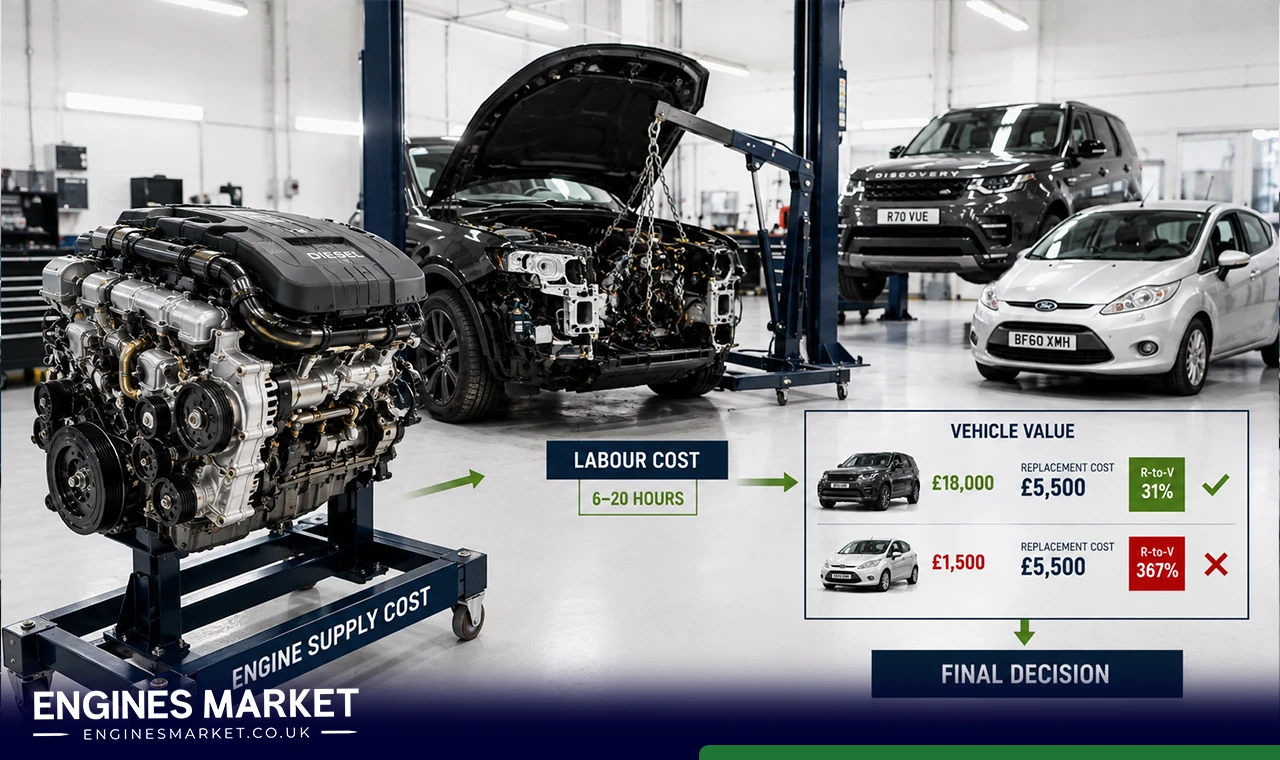
The cost of removing an old engine and fitting a new one is a major part of the total. The time required (R&R Labour Hours) varies significantly depending on the engine layout and vehicle.
Complexity: A compact 4-cylinder engine like the Ford DV6 might take 6-8 hours, whereas the intricate V8 in a Land Rover can take 16–20 hours.
Access: The BMW N47 chain is rear-mounted, increasing labour time for repairs, which is a key reason why many owners opt for a full replacement.
Regional Rates: Labour rates for an independent garage can range from £60 to £160+ per hour [INDUSTRY ESTIMATE], with London and the South East commanding higher rates.
Vehicle Value (The R-to-V Decision)
This is the most critical variable that our rating system is designed to highlight. A £5,500 engine is a large investment, but its financial sensibility depends entirely on the car it's going into.
The R-to-V (Replacement Cost to Vehicle Value) logic is simple: Is the cost of the replacement justified by the value and expected remaining life of the car? We use the following flag system to guide your thinking:
✅ Safe: The replacement cost is well within the vehicle's value. This is common for newer, higher-value vehicles like a BMW 3 Series G20.
⚠️ Watch: The replacement cost is a significant proportion of the vehicle's value (40–70%). This is typical for older, mid-value cars, such as a BMW 3 Series F30 with an N47 engine.
🔴 Scrap Threshold: The replacement cost risks approaching or exceeding the vehicle's value. This is often the case for older budget cars, like a Renault Megane III with a K9K 1.5 dCi engine.
If the lowest viable replacement cost exceeds approximately 60% of the vehicle's current market value, evaluate scrap value before committing.
What We Don't Know
Acknowledging the limitations of our data is vital for building trust and setting realistic expectations. Here’s what our data doesn't tell you.
The Hidden Condition of a Used Engine
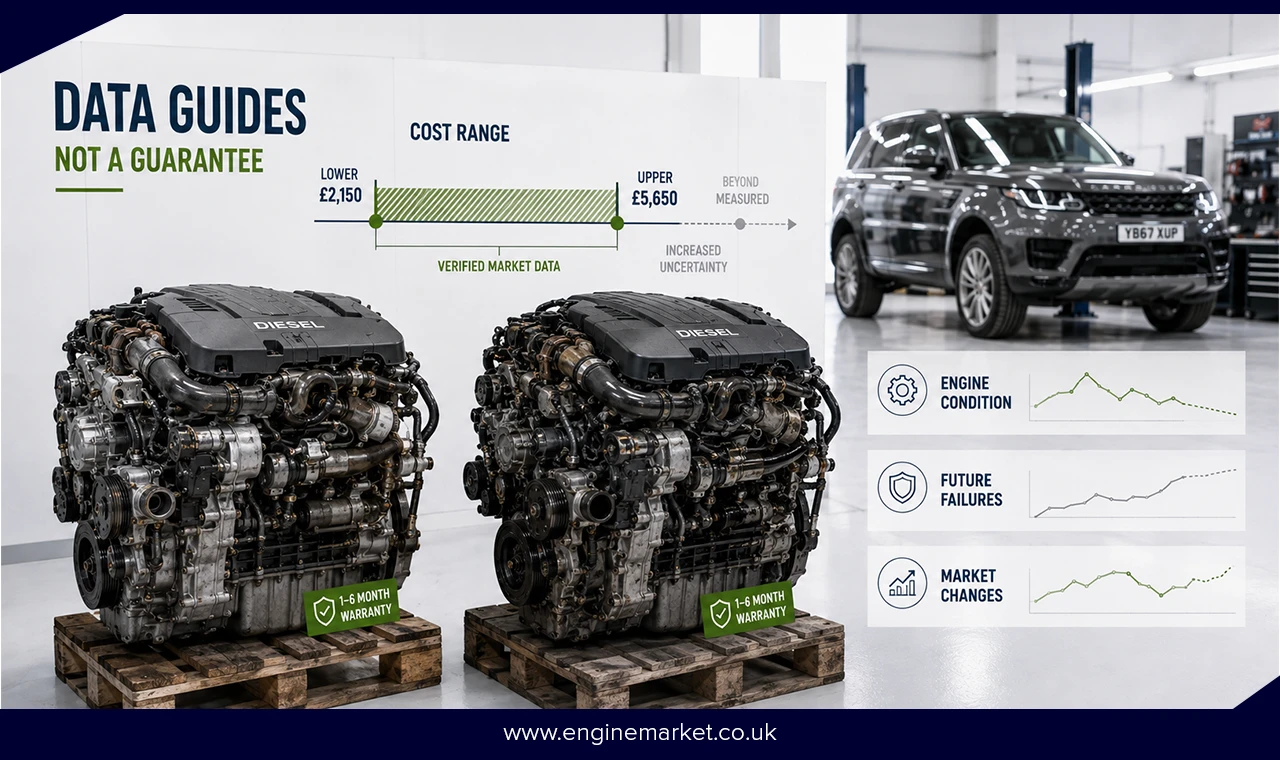
Our data on used engines is based on what was requested and quoted for. It does not guarantee the condition of a specific used engine. You can have two identical used engines from the same donor car; one might fail after a few months while another lasts for years. The short warranty (1–6 months) on most used units reflects this uncertainty.
Future Failures
No dataset can predict the future. While the Known Failure Patterns table [EM-VERIFIED] documents common issues like timing chain stretch on the BMW N47 or crankshaft bearing failure on the Land Rover 306DT, it does not provide a failure percentage. We can tell you what can go wrong and what it costs to fix, but we cannot tell you with certainty that your specific engine will fail.
DIY or Salvage Cost
Our cost intelligence focuses on the professional replacement market. It does not include the potential savings (or risks) of a DIY engine swap or buying a completely untested salvage engine from a scrapyard. Our data is built for transparency and commercial reality, not for the cheapest possible “do-it-yourself” approach.
All Variables are Subject to Change
The engine replacement market is dynamic. Prices for used engines, labour rates, and vehicle values fluctuate over time. Our data is a current snapshot, not a fixed future guarantee.
How to Use Our Data Effectively
Our data and rating system are powerful tools when used correctly. Here’s how to get the most out of them.
Use the R-to-V Flags to Guide Your Thinking
Don't just look at the cost of the engine. The R-to-V flag is your most important guide. It answers the most fundamental question: “Is it worth fixing this car?” Use the flags in the Model Ownership Decision Table to compare your vehicle’s value against the replacement cost.
Don't Confuse Request Volume with Reliability
It's tempting to assume a high volume of quote requests means an engine is unreliable. This is often a fallacy. The BMW N47D20C has a high request volume due to a known timing chain weakness, but also because it's a hugely popular engine in the UK. In contrast, the Land Rover 306DT SDV6 has a lower request volume but a much higher cost and more catastrophic failure mode. Use the Known Failure Patterns table for reliability insights, not just request volumes.
Always Factor in Labour
An engine that looks cheap ‘supply only’ can become expensive once labour is added, especially if it requires more hours due to its design or accessibility. Always compare the ‘fitted’ cost range.
Get a Quote for Your Vehicle
Our data provides a comprehensive range, but your specific situation is unique. The final cost will depend on your car's exact model, year, engine code, and the specific specialist you choose. The next step is always to get real quotes matched to your vehicle.
FAQs
Is engine replacement cost data reliable?
Yes, when derived from a large, real-world dataset. Our data from 24,650 enquiries [EM-VERIFIED] provides an accurate picture of the UK market. However, no data can produce a single fixed price, as final costs depend on vehicle-specific factors like condition and labour rates.
Why do engine replacement costs vary so much?
Costs vary for three main reasons: the supply cost of the engine itself, the labour required to fit it (which depends on the vehicle's complexity), and the R-to-V (Replacement-to-Value) ratio, which determines if the investment is financially sensible.
Can I trust online engine cost guides?
You can trust those that are transparent about their data sources and limitations. A guide that doesn't explain its methodology, uses generic averages, or doesn't factor in vehicle value should be treated with caution. Our guide is built on 24,650 real quote requests [EM-VERIFIED] and evidence-led analysis.
What affects engine replacement cost the most?
The condition of the replacement engine is the biggest variable. A used engine is cheaper but has a limited warranty. A reconditioned engine offers a better balance of cost and reliability and is the choice of 70.45% of our customers [EM-VERIFIED]. Labour rates and the complexity of the engine design are also major factors.
How accurate are your engine cost estimates?
Our estimates are highly accurate for market intelligence purposes. They are based on our proprietary data [EM-QUOTE] and real market conditions. They are a guide to help you make a decision; a final accurate quote will depend on your specific vehicle and chosen supplier.
Conclusion
Engine replacement cost data is never perfect, and it would be misleading to pretend otherwise. The final price depends on a complex interplay of supply, labour, and the specific vehicle it’s going into.
The value of our data lies in its evidence-led transparency. By combining our proprietary data from 24,650 real quote requests with our R-to-V flag system and known failure patterns, we provide the most accurate and useful UK engine cost intelligence available. This allows you to make a confident, informed decision.
See What Your Engine Replacement Costs From UK Specialists
Compare quotes for your exact vehicle at EnginesMarket.co.uk. Get real, transparent prices from our network of vetted specialists.