
The EM Verdict: How We Rate Every Engine We Cover

The EM Verdict answers one question: "Is replacing this engine financially sensible, and which replacement route should you choose?"
Unlike traditional reliability surveys that rely on owner opinions, the EM Verdict combines three proprietary data layers: 24,650 real quote requests [EM-VERIFIED], 62 engine cost curves from supplier quote data [EM-QUOTE], and mechanic-validated failure patterns from 100+ UK specialists [EM-INTERVIEW].
EnginesMarket.co.uk is a UK engine replacement price comparison marketplace. We don't sell engines or run a garage. We analyse real data from our marketplace to help UK vehicle owners make financially sound engine replacement decisions.
For the full methodology and the complete 2025 dataset (24,650 enquiries, 62 engines, 300+ models), see the Engine Market Intelligence Hub.
What Is the EM Verdict?
The EM Verdict is our proprietary engine rating system. It doesn't tell you whether an engine is "good" or "bad" in abstract terms. It tells you whether replacing that engine—and the vehicle it powers—makes financial sense.
Every rating answers three questions:
How much does a replacement cost? (used, reconditioned, rebuilt)
What failures are common? (validated by mechanics and manufacturer TSBs)
Is replacement worth it? (relative to the vehicle's current value)
The result is a practical verdict: safe to replace, watch carefully, or scrap threshold.
The Five Data Badges: How We Know What We Know
Every claim in our content carries a badge that tells you exactly where the information comes from. This isn't decorative—it's our quality guarantee.
How We Determine Every Rating
The EM Verdict is built from three proprietary data layers. Each layer adds a different dimension to the rating.
Layer 1: Request Volume (What Owners Actually Ask For)
Our dataset contains 24,650 unique engine replacement quote requests from 2025. This tells us which engines UK vehicle owners are actually asking about—not what forums or surveys say they should worry about.
Top five most-requested engines in 2025:
Important: Request volume ≠ failure rate. High enquiry numbers may reflect large vehicle parc, age profile, or audience bias—not engineering quality. The N47D20C generates 1,450 requests because there are many BMW diesels on UK roads, not because it's the worst engine ever built.
Layer 2: Cost Curves (What Replacement Actually Costs)
We maintain a full cost database for 62 engines, cross-referenced against actual supplier quotes sent through our marketplace.
Example cost curves (supply only):
Source: Table A — Engine Replacement Economics [EM-QUOTE].

Layer 3: Failure Patterns (What Goes Wrong, When, and at What Cost)
We triangulate failure patterns from four channels:
Customer enquiry descriptions (free-text problem statements from 24,650 quote requests)
Supplier quote notes (mechanics listing specific failures when quoting)
Post-sale customer surveys (100+ customers 3–6 months after replacement)
Manufacturer TSBs and public forum validation (Tier 1 and Tier 2 sources)
Example failure pattern: BMW N47D20C
Source: KNOWN FAILURE PATTERNS table [EM-INTERVIEW + THIRD-PARTY].
Early warning: Cold-start rattle. Catastrophic if ignored.
The R-to-V Flag System
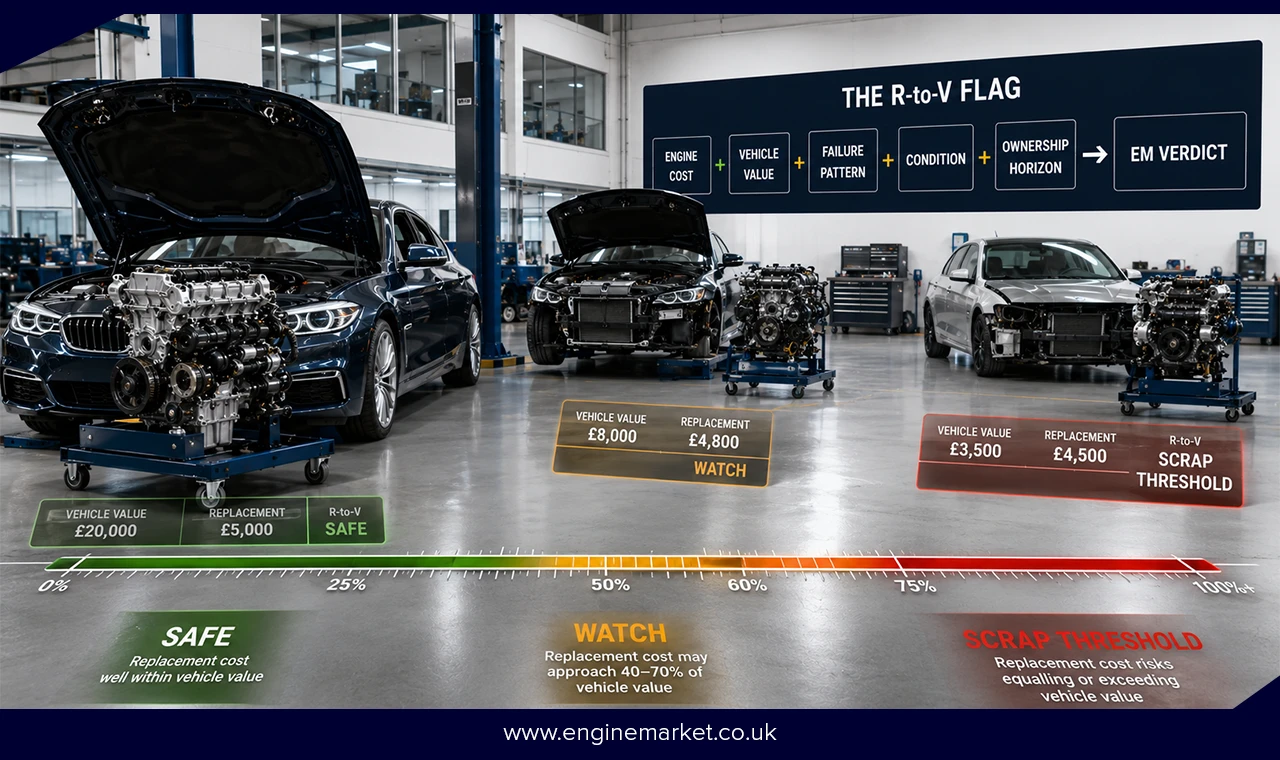
The final piece of the EM Verdict is the R-to-V (Replacement-to-Value) flag. This tells you whether replacement cost is financially sensible relative to the vehicle's current market value.
What Each Flag Means
R-to-V in Practice
Example: BMW N47D20C in a 2012–2018 F30 3 Series
Sub-£8k F30 examples: recon cost reaches 60–80% of value. Evaluate carefully.
Example: BMW N47D20C in a 2004–2011 E87 1 Series
Most E87 hosts are under £4k. Recon cost typically exceeds vehicle value.
Source: Model Ownership Decision Tables [EM-QUOTE + THIRD-PARTY].
How We Validate Failure Patterns
We don't invent failure patterns. Every entry in our KNOWN FAILURE PATTERNS table is validated against multiple sources:
Tier 1: Manufacturer Technical Service Bulletins (TSBs) and official recalls
Tier 2: Public forums, Honest John, Parkers—used for validation, not sole authority
Proprietary: Enquiry patterns from 24,650 quote requests [EM-VERIFIED]
Example validation chain: Mercedes OM651
Customer pattern: 1,250 quote requests [EM-VERIFIED]
Supplier notes: Specialists reporting timing chain tensioner wear, injector seal failure
Manufacturer TSB: LI80.20-P-050001 (timing chain tensioner)
Published validation: Honest John, Parkers owner reports
This triangulation means our failure patterns are robust—and our readers can trust them.
The EM Verdict in Action: Three Engine Walkthroughs
Walkthrough 1: BMW N47D20C (Highest-Volume Engine, 1,450 Requests)
Verdict: The N47 is the UK's most-requested replacement engine, driven by well-documented timing chain issues. Replacement is viable in higher-value hosts (post-2015 F30, mid-range F20), but older hosts (E90, E87) frequently fall into scrap territory. Evaluate carefully—a £3,200–£5,500 recon cost makes no sense in a £2,000 car.
Walkthrough 2: Land Rover 306DT TDV6/SDV6 (High-Volume, High-Cost Failure)
Verdict: The 306DT is a high-cost, catastrophic failure engine. Crankshaft bearing fatigue is the primary risk, and cold-start knock is the early warning. However, because Land Rover/Range Rover hosts retain strong values, replacement remains financially defensible. Reconditioned is the default route for most owners.
Walkthrough 3: Ford DV6 1.6 TDCi (Volume Benchmark, Budget Host)
Verdict: The DV6 is a cheap engine with cheap replacements—which is exactly what volume-market owners need. However, sub-£3,000 Focus hosts frequently make replacement uneconomic. Where the lowest viable replacement cost exceeds approximately 60% of the vehicle's current market value, evaluate scrap value before committing.
Why EM Verdict Differs from Traditional Reliability Surveys
Traditional reliability surveys ask owners: "How reliable has your car been?"
The EM Verdict asks: "If your engine failed today, how much would it cost to replace—and would that be financially sensible?"
The EM Verdict is designed for one purpose: helping UK vehicle owners decide whether to replace an engine—and which route to choose.
Common Questions
How does EnginesMarket rate engines?
We rate engines using three proprietary data layers: (1) request volume from 24,650 real quote requests [EM-VERIFIED], (2) cost curves from actual supplier quotes [EM-QUOTE], and (3) mechanic-validated failure patterns [EM-INTERVIEW]. The final rating is expressed as an R-to-V flag: ✅ Safe, ⚠️ Watch, or 🔴 Scrap Threshold.
What data do you use to evaluate engines?
We use six data badge categories: EM-VERIFIED (our proprietary CRM data), EM-QUOTE (supplier pricing), EM-INTERVIEW (mechanic insights), EM-SURVEY (customer feedback), THIRD-PARTY (external sources like Auto Trader, manufacturer TSBs), and INDUSTRY ESTIMATE (workshop consensus where no verified data exists). Each badge tells you exactly where the information comes from.
Why do you rate some engines differently than other sites?
Traditional reliability surveys ask owners whether their car has been reliable. We ask what it costs to replace an engine if it fails—and whether that makes financial sense. A "reliable" engine with a £5,000 replacement cost can still be a poor financial decision in a £2,000 car. We prioritise real economics over abstract scores.
How reliable is your engine replacement cost data?
Our pricing data comes from actual supplier quotes sent through EnginesMarket.co.uk, cross-checked against 100+ UK engine specialists and validated against eBay Motors and PistonHeads classifieds. Pricing is labelled [EM-QUOTE] or [INDUSTRY ESTIMATE] depending on the source. We never invent prices.
What makes an engine "highly recommended" in your verdicts?
An engine earns a "highly recommended" verdict when: (1) replacement cost is well within vehicle value (✅ Safe flag), (2) the engine is widely available and well-supported in the UK, (3) parts are available, (4) specialists are available, and (5) common failure patterns are manageable and affordable. Our verdicts are based on economics, not abstract engineering quality.
Does request volume equal failure rate?
No. Request volume reflects what owners ask about, not how often an engine fails. The N47D20C generates 1,450 requests partly because there are many BMW diesels on UK roads. We never infer failure rate from request volume alone—we validate failure patterns through mechanic interviews and manufacturer TSBs.
Conclusion
The EM Verdict exists to cut through the noise. We don't care whether an engine has a "bad reputation" or a "good reputation" in isolation. We care about three things:
What does it cost to replace? (real quotes from UK specialists)
What failures are common? (validated, not invented)
Is it worth it? (relative to your vehicle's value)
Every engine we cover receives the same rigorous, data-driven treatment—so you can make a financially sound decision, not a guess.
See what replacement costs from UK specialists. Compare quotes for your exact vehicle at EnginesMarket.co.uk.
Not sure whether to repair or replace? Compare used, reconditioned and rebuilt options from vetted UK specialists.
Based on the cost range above, the next step is checking real quotes for your vehicle and engine code.