`r`n
Ford Transit V348 2.2 Duratorq Puma Engine Failure Representative Case Study

Ford Transit 2.2 Engine Failure - Why Downtime Cost More Than the Engine

A premium visual breakdown of black smoke, wasted DPF repairs, bore wash from failed injectors, and the decision to fit a reconditioned engine with turbo - prioritising uptime over repair cost.

"Black smoke pouring out the back. Failed the MOT on emissions. The driver said it was using a litre of oil every 500 miles. We'd already spent £1,200 on a new DPF and EGR valve. Three months later, the same problems came back. That's when the mechanic said, 'The injectors are wrecked. They've washed the bores. The rings are gone. You need an engine.'"
105kFirst symptom
£1,200Wasted repairs
£3,800Engine fitted
£4,600Final total
18 moWarranty
Case summary

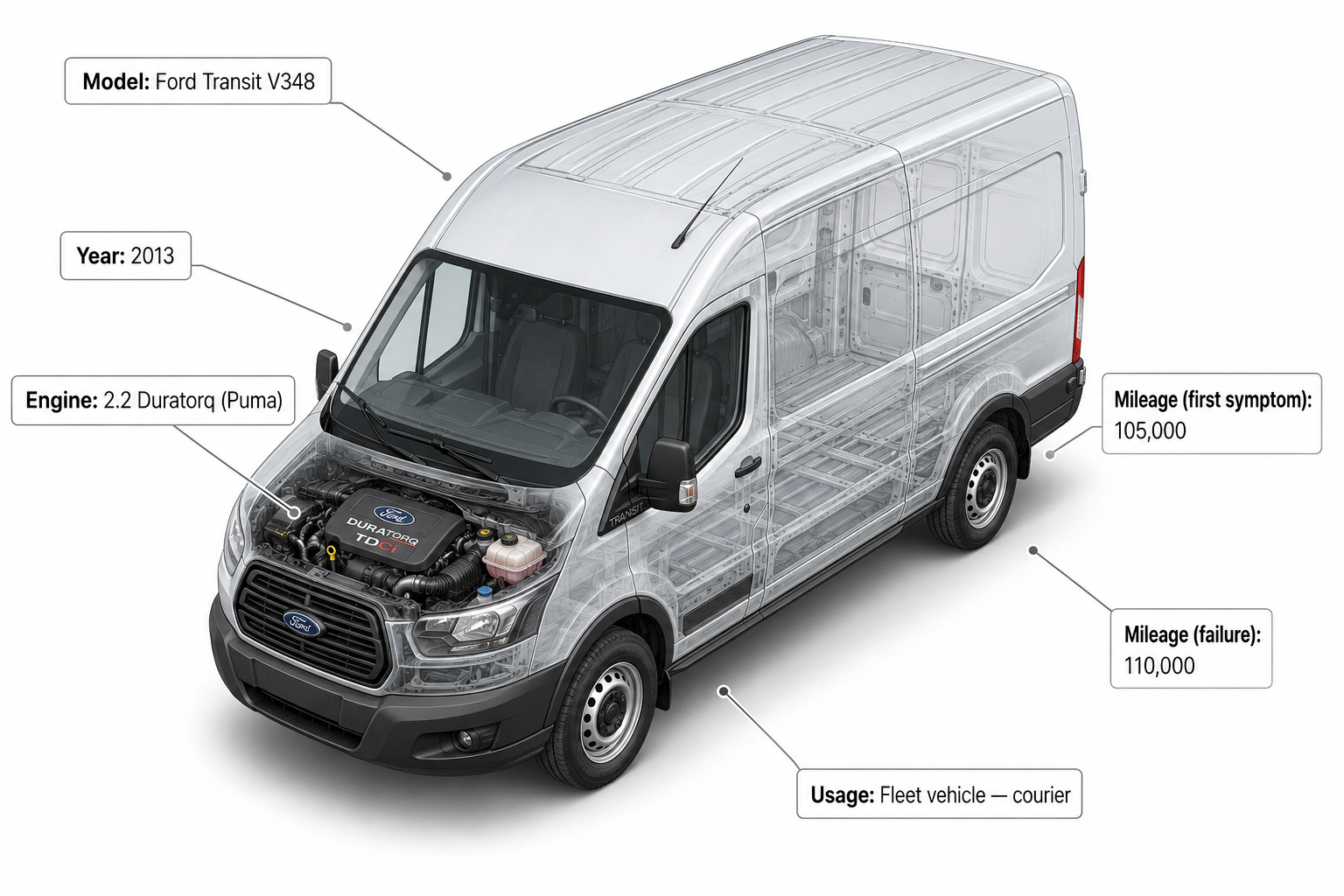
A 2013 Transit with 110,000 miles - fleet vehicle for courier work.

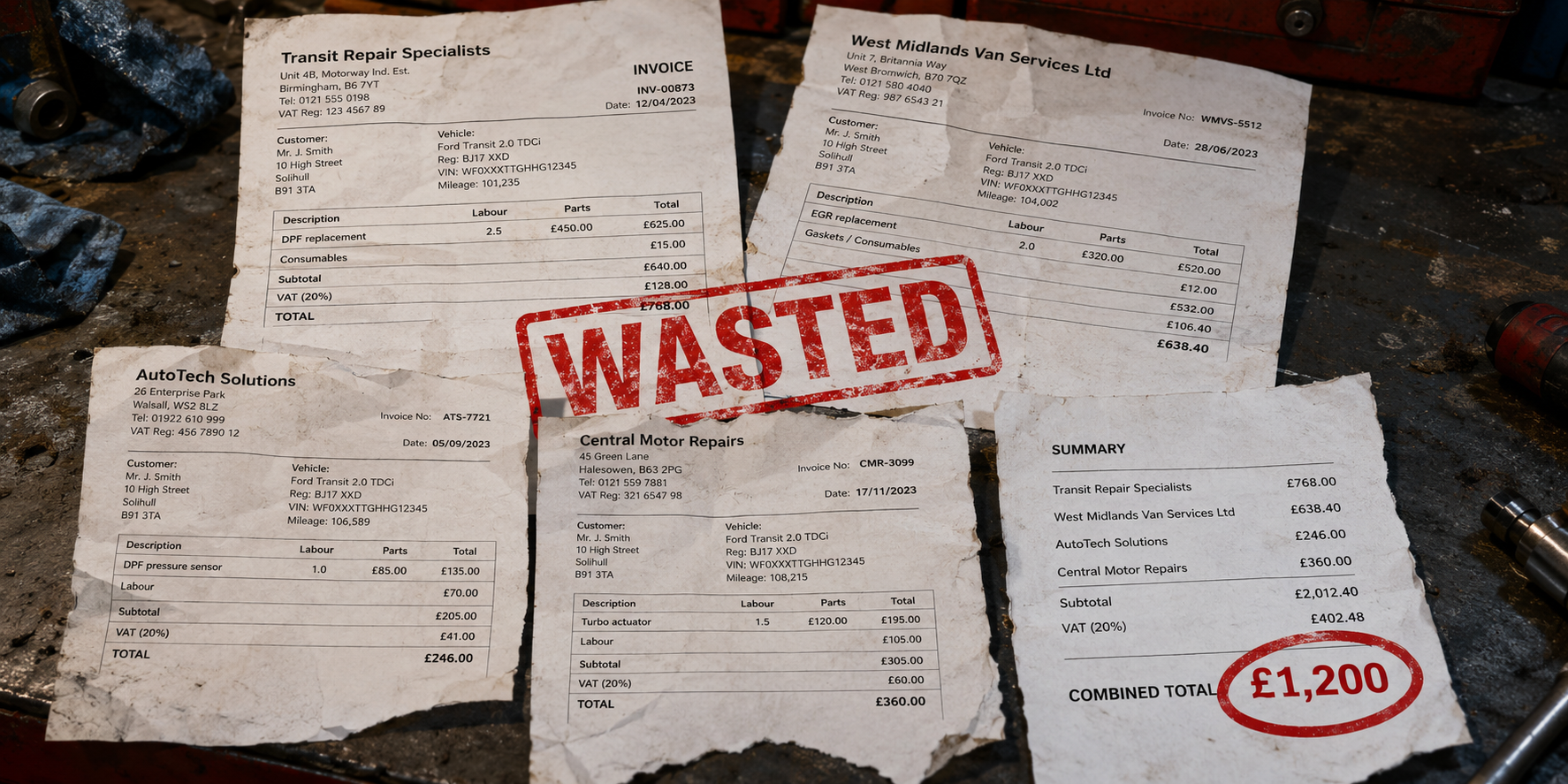
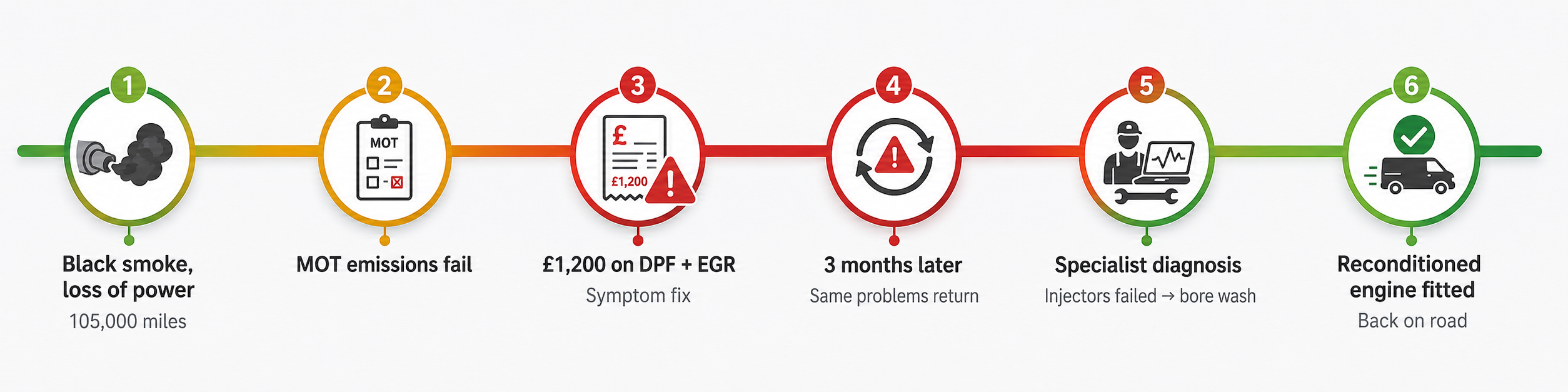
The fleet manager first noticed black smoke from one of the Transits under acceleration. The driver reported a gradual loss of power, particularly up hills. The van failed its MOT on emissions. An independent garage diagnosed a clogged DPF and failing EGR valve - £1,200 later, the problems returned within three months.

ModelFord Transit V348
Year2013
Engine2.2 Duratorq (Puma) - 4-cylinder turbo diesel
Mileage at first symptom105,000 miles
Mileage at failure110,000 miles
UsageFleet vehicle - courier work, daily use
Disclaimer: This is a representative scenario based on common failure patterns observed across Ford Duratorq diesel family quote requests on Engines Market in 2025 [ESTIMATED - using Ford DV6 1.6 TDCi enquiry data (n=780) and Ford Duratorq 2.2 TDCi (n=300) as proxy], combined with workshop consensus and KNOWN FAILURE PATTERNS data. Individual outcomes vary.
Isometric 3D render of 2013 Ford Transit V348 with 2.2 Duratorq diesel engine and vehicle specifications
The first clue

Black smoke under acceleration - treated as a DPF issue, not injectors.

The fleet manager first noticed black smoke from the Transit under acceleration. The driver reported a gradual loss of power, particularly up hills. The van failed its MOT on emissions. An independent garage diagnosed a clogged DPF and failing EGR valve.

Ford Transit wasted repair invoices showing £1,200 spent on DPF and EGR that didn't fix the underlying problem
What they thought"Standard DPF issues on a high-mileage Transit."

Replace the parts, problem solved.

What it actually wasFailed injectors causing bore wash

Worn injectors over-fuelling, washing oil from bores, destroying rings.

The breaking pointOil consumption at 1 litre per 500 miles

DPF warning back. £1,200 wasted. Engine replacement required.

According to [KNOWN FAILURE PATTERNS] data for Ford Duratorq engines, injector failure is common between 80,000 and 150,000 miles, with symptoms including black smoke, loss of power, and failed emissions.
Failure timeline

£1,200 in wasted repairs - and the same problems came back within 3 months.

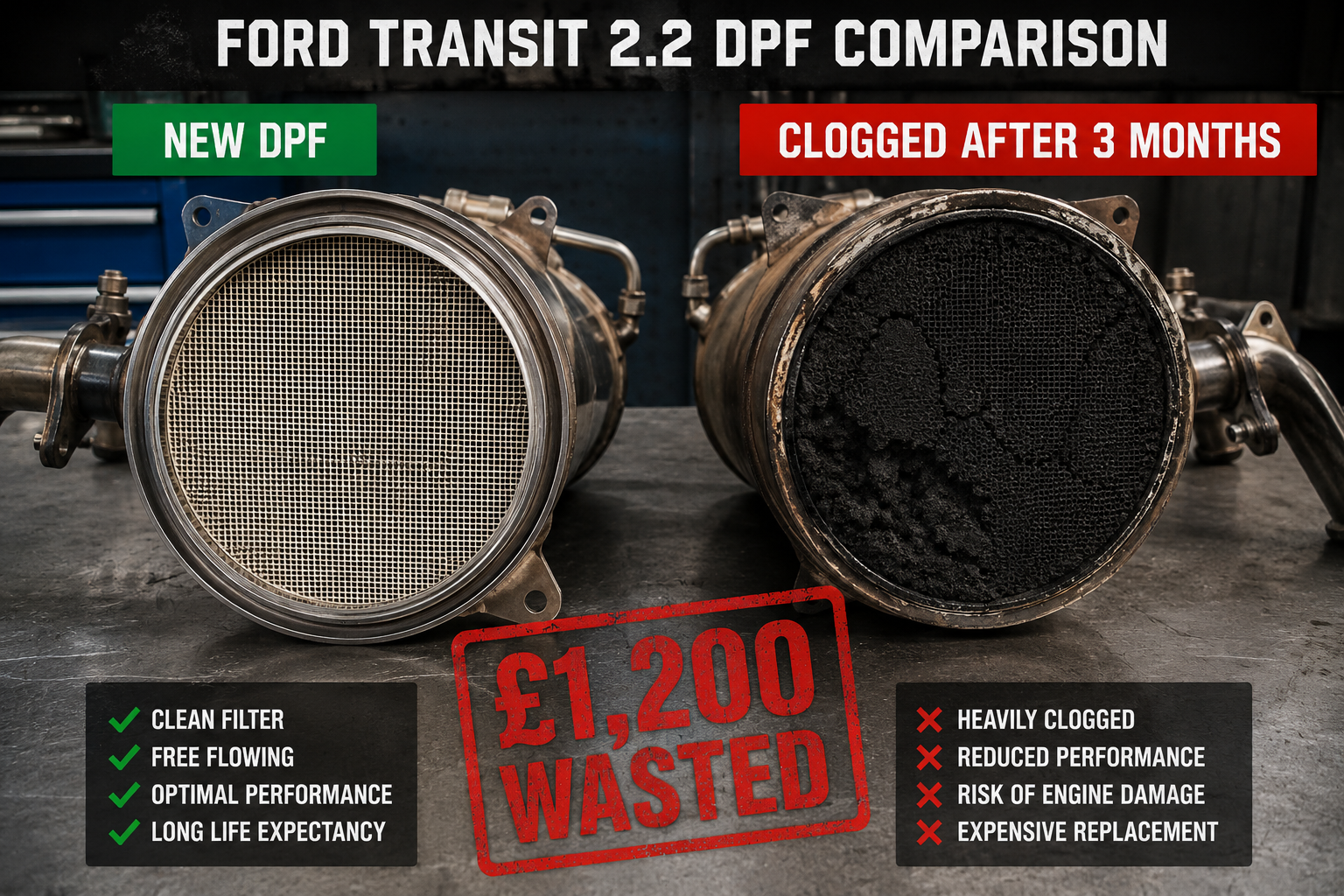
The worn injectors were over-fuelling the engine. Unburnt diesel was washing the oil from the cylinder bores - a condition known as "bore wash." This wore the piston rings, causing excessive oil consumption. The excess fuel was also rapidly clogging the new DPF.

Ford Transit 2.2 timeline showing wasted repairs and progression to engine replacement
What the manager thought

"Replace the DPF and EGR. Standard high-mileage Transit issues."

What it actually was

Failed injectors over-fuelling for months. Killed the DPF and EGR. Wore the rings and bores. £1,200 wasted.

Workshop diagnosis

The specialist confirmed failed injectors, bore wash, and scored cylinders.

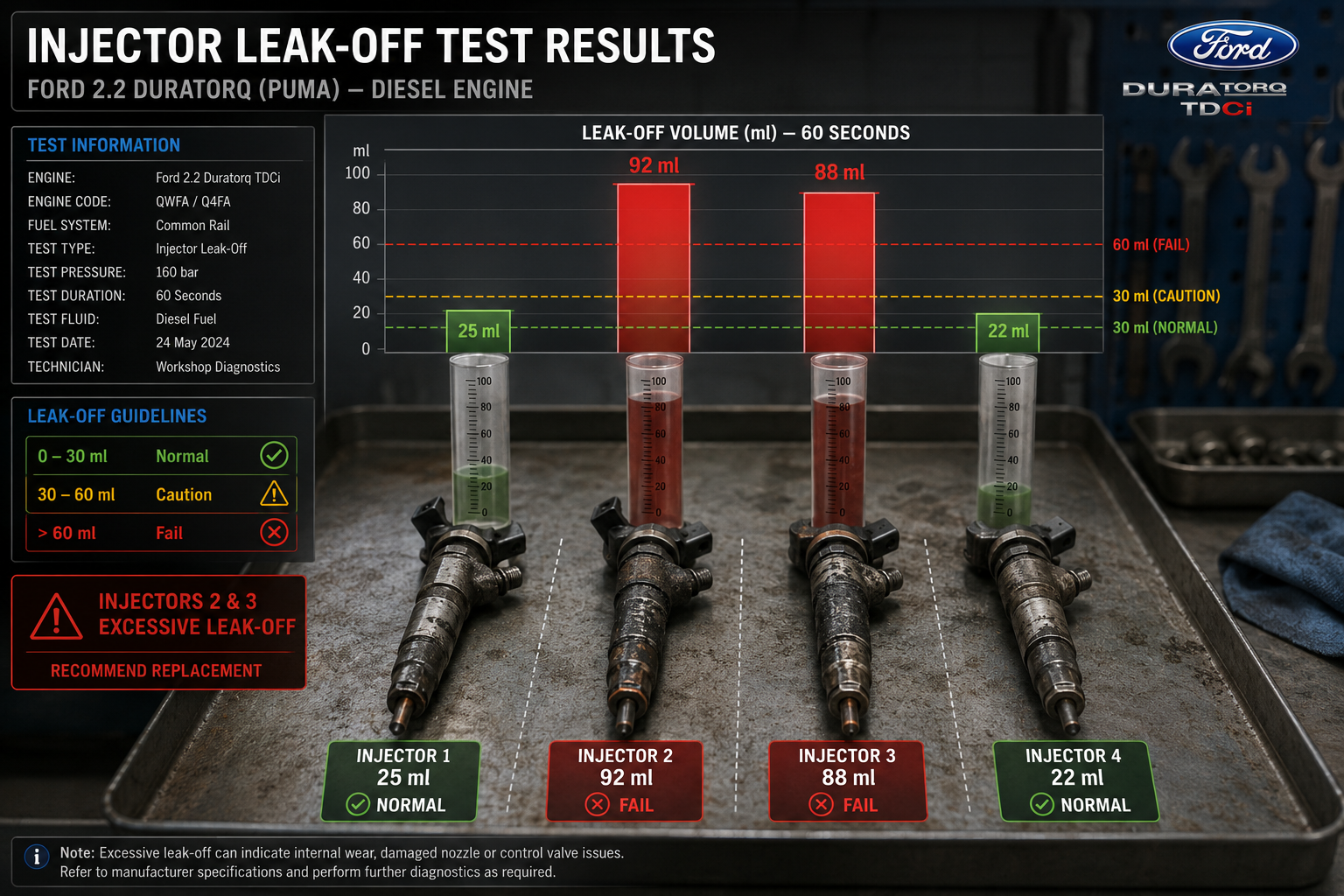
The specialist performed a compression test, injector leak-off test, and borescope inspection. The findings were severe - the engine needed a full rebuild or replacement.

Ford 2.2 Duratorq leak-off test showing failed injectors on cylinders 2 and 3
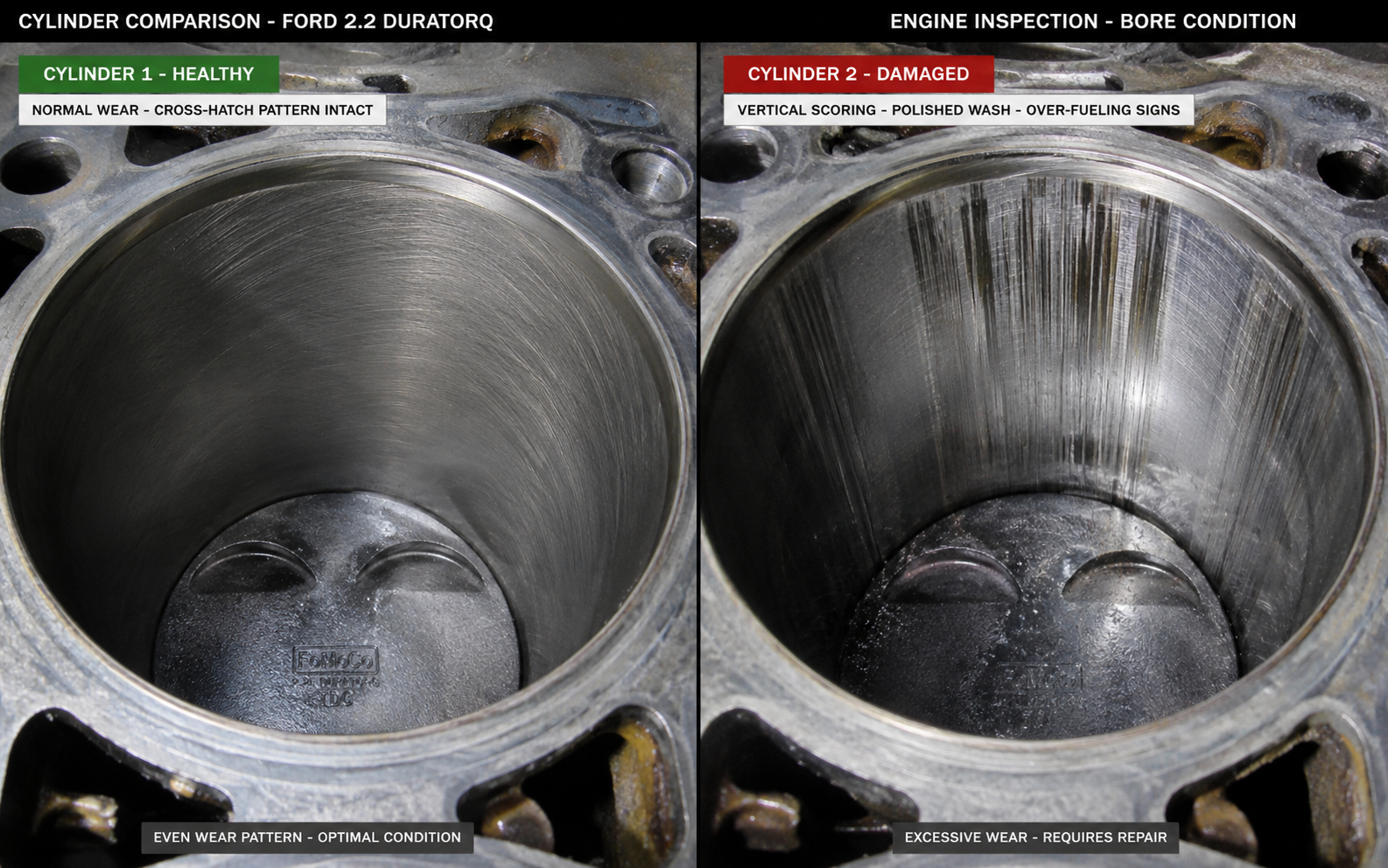
Ford 2.2 Duratorq cylinder bore scoring from bore wash caused by failed injectors
Ford Transit 2.2 DPF clogged after 3 months due to failed injectors over-fuelling
Injectors (cylinders 2 & 3)Failed - excessive leak-off, poor spray pattern
Piston ringsWorn - bore wash damage, excessive oil consumption
Cylinder boresScoring visible on cylinder 2
DPFRapidly clogging again - ash load high despite new unit
EGR valveCarboned up
TurbochargerUnknown condition - possible oil contamination from blow-by
Specialist summary

"The injectors failed first. They've been over-fuelling for months. That killed the DPF and EGR, and it's worn the rings and bores. You can replace the injectors and rings, but the bores are scored. This engine needs a full rebuild or replacement. The £1,200 you spent on the DPF and EGR was wasted - the injectors killed them again."

Repair options

Three choices: rebuild, reconditioned exchange, or new dealer engine.

The specialist presented three distinct paths. For a fleet vehicle, downtime was the hidden cost that made the exchange engine the clear winner.

Long downtime

Engine Rebuild (On-Site)

£2,500-£4,000

Remove engine, rebore cylinders, fit oversized pistons and rings, new injectors, DPF, EGR.

Lead time10-14 days (engine out, machine shop)
Warranty6-12 months
Key riskDowntime costs for a fleet vehicle can exceed repair costs
Hidden cost10-14 days lost revenue: £1,000-£2,000+
Recommended - chosen

Reconditioned Engine (Exchange)

£2,500-£5,000

Fully reconditioned long engine with new rings, bearings, gaskets; tested injectors. Exchange basis.

Case cost£3,800 fitted (engine only)
Lead time2-3 days (exchange basis)
Warranty18 months / 18,000 miles
What's includedFully reconditioned long engine; old engine returned for core surcharge
Best forFleet operators where downtime is critical
Dealer route

New Ford Engine

£6,000-£9,000+

New Ford crate engine with full dealer warranty.

Supply cost£4,000-£6,000+ [THIRD-PARTY - Ford dealer pricing]
Warranty24 months, Ford
Lead time7-14 days
Key upsideZero-mile factory engine
Best forVehicles under warranty or insurance claims
The uncertainty play

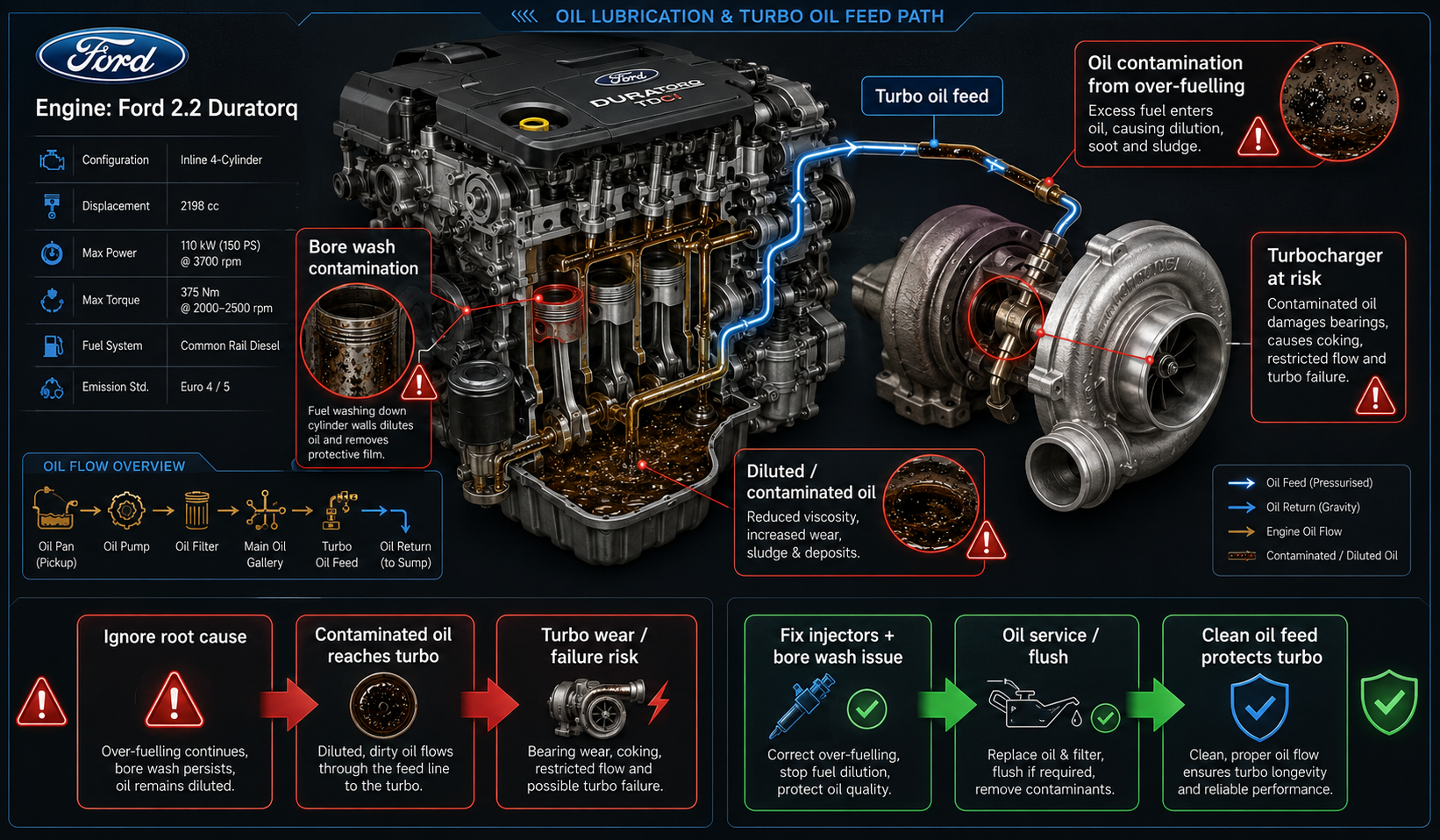
Bore wash creates risk beyond the visible cylinder scoring.

When the specialist removed the injectors and inspected the bores, they found scoring on cylinder 2 that could be felt with a fingernail. The excessive oil consumption from the worn rings meant the turbo had been running with reduced oil quality.

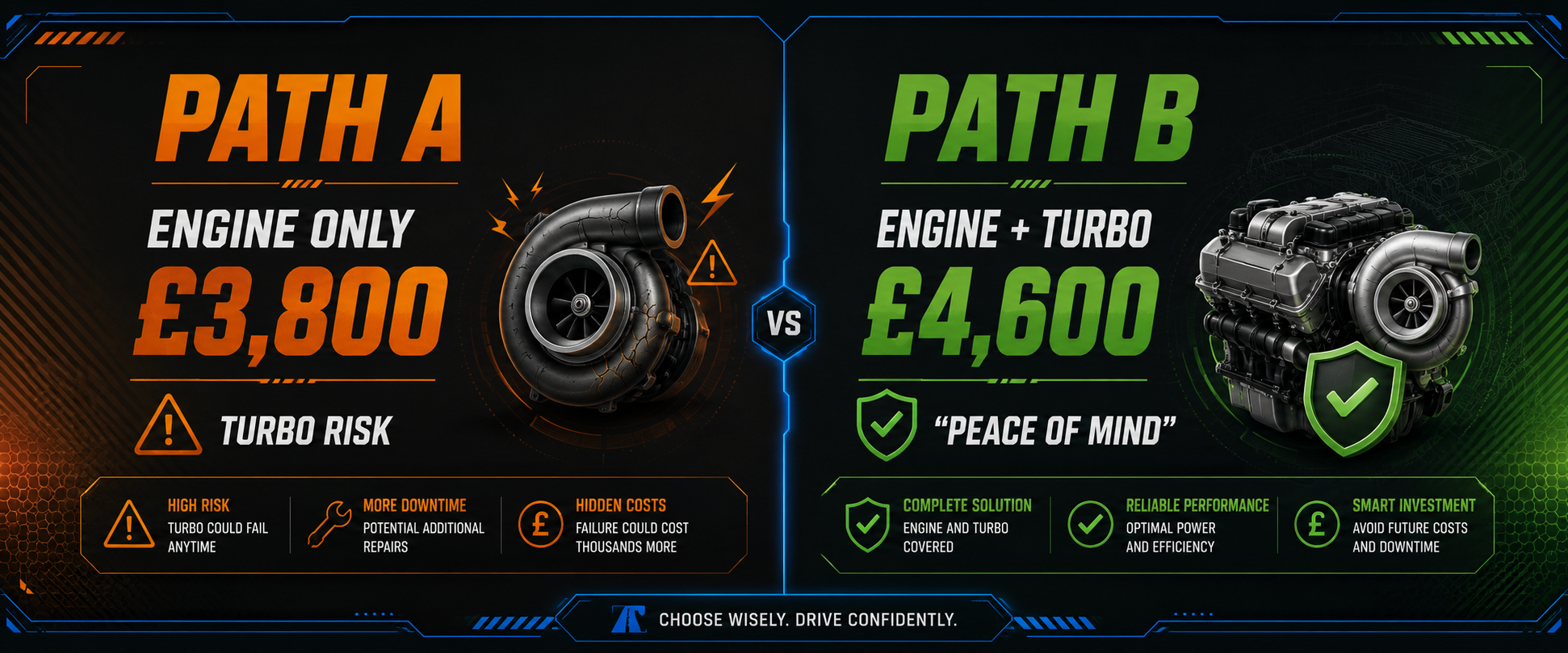
Path A

Exchange reconditioned engine only - take the risk on the existing turbo.

£3,800

If turbo fails later: add £800-£1,200 + labour.

Ford 2.2 Duratorq turbo contamination diagram showing oil contamination risk from bore wash
The fleet manager chose Path B - prioritising reliability and uptime over upfront cost. A turbo failure on a Transit would add £800-£1,200 to the bill - plus labour and downtime.
Fork in the road

Downtime was the real cost - an exchange engine got the van back in 2 days.

The vehicle was worth approximately £6,000-£10,000 as a runner [THIRD-PARTY - Auto Trader, March 2025]. A rebuild at £2,500-£4,000 plus 10-14 days of lost revenue was less cost-effective than an exchange engine at £3,800 with 2-3 days of downtime.

Ford Transit repair decision - engine only at £3,800 with turbo risk versus engine and turbo at £4,600 with peace of mind
Engine rebuild (on-site)Path 1

£2,500-£4,000. 10-14 days off-road. Lost revenue: £1,000-£2,000+.

Exchange reconditioned enginePath 2 - chosen

£4,600 (engine + turbo). 2 days off-road. Back earning money quickly.

The manager's calculationWhy

"The rebuild is cheaper on paper. But 10 days off the road costs me £1,500 in lost revenue. The exchange engine is back on the road in 2 days. The extra £800 for the turbo is insurance against another failure. I can't afford to do this twice."

£6,000-£10,000Vehicle value

£3,800 repair = ~38-60% of value - acceptable for a commercial vehicle.

Daily courier useFleet utilisation

Downtime cost exceeded £100/day in lost revenue.

£1,200 wastedPrevious repairs

DPF and EGR failed due to injectors. Manager accepted the loss and moved to full replacement.

18 monthsWarranty

Peace of mind for fleet manager with reconditioned engine warranty.

LowRisk tolerance

Could not afford repeat downtime. Chose Path B (preventative turbo replacement).

£4,600Total spend

Reconditioned engine + turbo. 18-month warranty. Van back in 2 days.

Reconditioned engine + turbo - chosen for uptimeFinal verdict

The exchange engine cost more upfront, but it fixed everything in one go. The van was back earning money in 2 days. The extra £800 for the turbo was insurance against another failure.

Outcome

What happened after the replacement-

The fleet manager paid £4,600 for a reconditioned engine and turbo - supply and fit. The van was back in service in 2 days. The £1,200 spent on DPF and EGR was written off as a learning experience.

Final engine + turbo£4,600
Wasted repairs£1,200
Total spend£5,800
Lead time2 days
Warranty18 months / 18,000 miles
Long-term resultNo further issues at 130,000 miles
"The £1,200 on the DPF and EGR was a mistake. We treated the symptoms, not the cause. The exchange engine cost more upfront, but it fixed everything in one go. The van was back earning money in 2 days. That's worth every penny."
Blurred Ford workshop background with Transit on ramp for repair outcome quote card
Lessons learned

If your 2.2 Duratorq Transit has black smoke - test the injectors first.

A £500 injector service could save a £3,800 engine. Treating symptoms with DPF and EGR replacement wastes money and time. For fleet operators, downtime is the real cost - an exchange reconditioned engine with a 2-day turnaround is almost always better value than a 10-day rebuild.

Injector leak-off test at first symptom£50-£150

Identifies failing injectors before bore wash occurs.

Injector replacement (caught early)£500-£1,000

Engine continues to run safely. DPF and EGR survive.

DPF and EGR replacement (treating symptoms)£1,200+

Problems return within months - injectors are still failing.

Reconditioned engine (after bore wash)£3,800+ (plus turbo)

Van off the road 2-3 days. £1,200 wasted on previous repairs.

A £500 injector replacement would have saved £1,200 in wasted DPF/EGR repairs and prevented bore wash entirely. Acting on the first symptom could have saved over £4,000.
Click to expand - Ford Duratorq 2.2 (Puma) OEM part numbers
ComponentFord OEM Part Number
Injector (remanufactured, each)BK2Q-9K546-AA
Injector seal kit (per injector)BK2Q-9K546-AB
Piston ring set (per cylinder)BK2Q-6148-AA
Cylinder head gasket setBK2Q-6051-AA
Crankshaft bearing setBK2Q-6333-AA
Conrod bearing setBK2Q-6211-AA
Oil pump assemblyBK2Q-6600-AA
Timing chain kitBK2Q-6K255-AA
DPF (diesel particulate filter)BK2Q-5H270-AA
EGR valve assemblyBK2Q-9D475-AA
Turbocharger (remanufactured)BK2Q-6K682-AA
Oil filterBK2Q-6714-AA
Sump gasketBK2Q-6710-AA
Get a quote

Need a real quote for your Ford Transit 2.2-

Compare quotes from UK Ford specialists for injector failure, bore wash damage, reconditioned engines, turbos, and full replacement options for your Transit.

Data sources used in the content: Engines Market 2025 internal quote data, workshop consensus, third-party vehicle market references, and known Ford Duratorq failure-pattern data.

Quick quote check

Replace this mock form with your live lead form or Elementor shortcode.

`r`n